Skip to content
AC GarlandGarland, TexasCall (469) 804-6158

AC replacement

AC replacement and installation in Garland, Texas

Buying a new central air system is a big, infrequent decision. This page walks through the rules and choices that shape it in Garland, so the proposals you get are easier to compare.

When replacement comes up

Few people replace a working air conditioner for fun. The question usually arrives with a failed compressor, a coil that leaks again after a repair, or a technician pointing out that the equipment is past its second decade.

The EPA suggests having a professional evaluate any system more than 10 years old or one that no longer keeps the house comfortable. That evaluation is worth more than the age alone: a well-kept unit can outlast a neglected newer one.

  • The compressor has failed and the system uses R-22.
  • The indoor coil or the condenser has leaked more than once.
  • Some rooms never cool down even when the equipment runs all afternoon.
  • Repairs in the last few years add up to a large share of what a new system would take.

Outdoor air conditioning condenser on a concrete pad beside a red-brick house, with a crape myrtle and a wood fence

The 2026 refrigerant rule

Under the EPA's Technology Transitions rule, its frequent questions page says any new split system installed after January 1, 2026 must use a refrigerant with a global warming potential below 700. That rules out R-410A for a complete new system.

The rule does not touch existing equipment. Owners can keep repairing a system through its useful life, and a failed outdoor unit or indoor coil can be swapped for a matching R-410A part. Replacing both at once counts as a new system, so both pieces then have to meet the lower limit.

In practice, ask every contractor which refrigerant the proposed equipment uses and whether the outdoor unit, indoor coil and line set are rated to work together.

What gets replaced, and what can stay

A typical Garland system has three parts that work as one: the outdoor condenser, the indoor coil that sits on the furnace in the attic or a closet, and the copper lines joining them. Ducts, the thermostat and the furnace may or may not change with them.

A matched outdoor unit and coil are the core of a replacement. Whether the furnace, line set or ducts stay is a judgment the contractor should explain in writing.

How a split air conditioner moves heat out of a houseAn attic furnace with an indoor coil sends cooled air through ducts to the rooms. Two copper lines run from the coil to the outdoor condenser, which releases the heat outside.furnacecoilcool supply airreturn grille and filtercopper line setoutdoor condenserheat out
The cooling loop in a split system with an attic furnace.

Questions to settle for each part

Use this as a checklist when reading proposals side by side.

Outdoor condenser
Capacity in tons, efficiency rating, refrigerant, and the pad or stand it will sit on.
Indoor coil
Model number, whether it matches the condenser, and how it will fit the furnace cabinet.
Line set
Reused after flushing and testing, or replaced. Reuse depends on size, condition and refrigerant.
Furnace or air handler
Whether its blower can move the air the new coil needs. An old blower can hold back a new system.
Ducts and returns
Leaks, crushed runs and undersized returns limit any new equipment.
Thermostat
Whether the existing one works with the new equipment and its staging.
Electrical
Breaker size, the outdoor disconnect and the wire run must suit the new unit's rating.

Sizing comes first

A unit that is too big cools the air fast, shuts off, and leaves moisture behind, so the house feels clammy. One that is too small runs all day in August and still falls behind. Matching the old unit's size is a shortcut, not a method.

Ask how the contractor arrived at the tonnage. A room-by-room load calculation looks at windows, insulation, orientation and duct layout. If additions, new windows or attic insulation have changed the house since the last system went in, the right size may have changed too.

What the City of Garland expects on a change-out

Garland requires a permit when the condensing unit or the heating unit is replaced. The same city page lists the points an inspector looks for, several of which affect attic installs:

  • Units must be reachable for service and replacement without removing permanent construction.
  • An attic unit needs a catwalk or passage with solid flooring, a switched light at the passage opening and an outlet near the unit.
  • Every piece of equipment needs an electrical disconnect.
  • Refrigerant piping and fittings get insulation with a half-inch wall.
  • Condensate goes to an approved disposal spot, never into a street or alley.
  • Type B vent pipe keeps at least one inch from wood or insulation.

The city also says on its building permit page that mechanical contractors must be licensed by the state and registered with the city. If an attic lacks the walkway or the light, adding them is part of the job, which is one reason two quotes for the same equipment can differ.
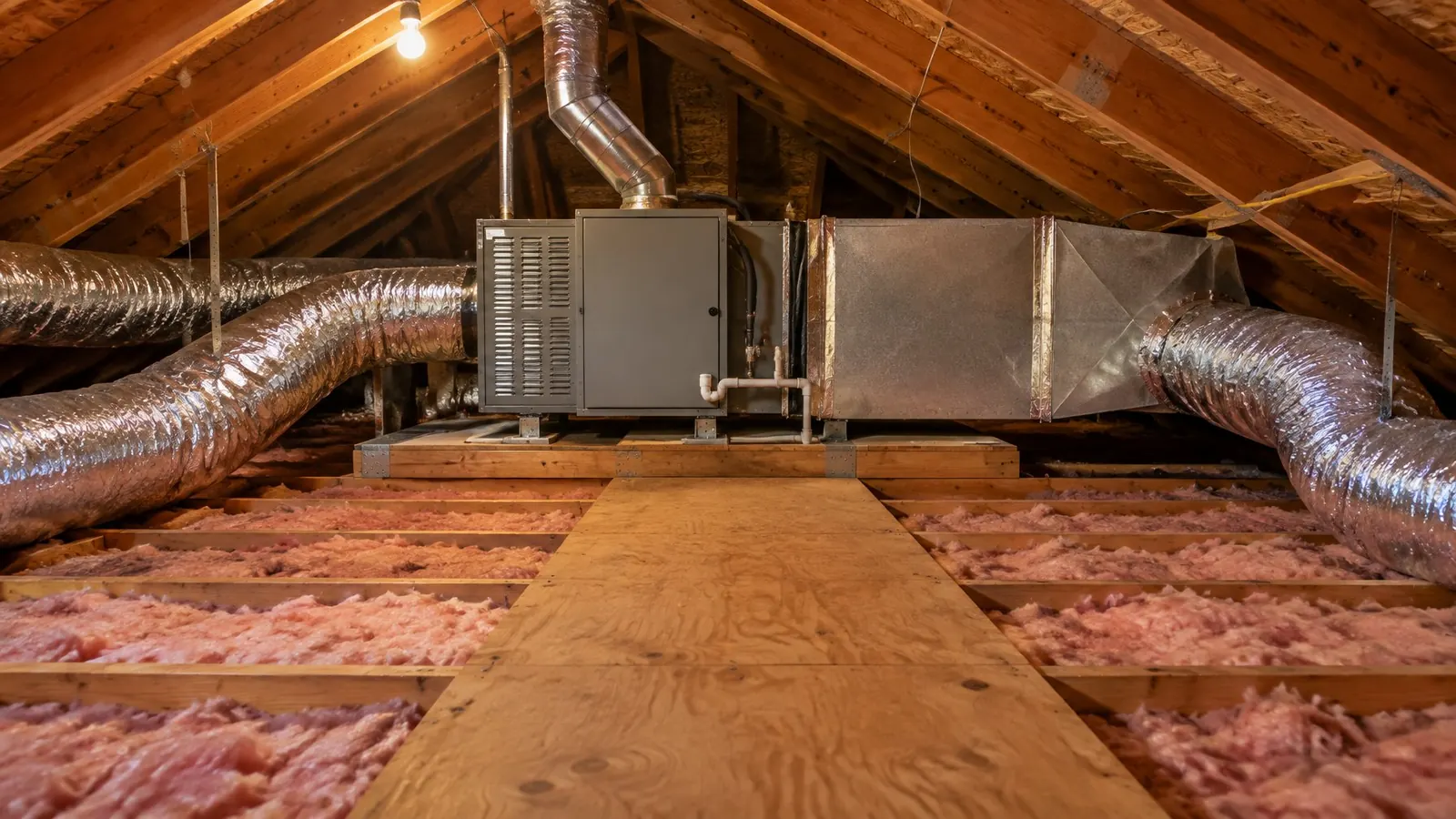
Gas furnace and coil cabinet in a house attic, reached by a plywood walkway, with a light bulb overhead

What drives the cost

No two houses price the same. These are the items that move a proposal up or down.

Capacity and efficiency
More tons and higher efficiency ratings both raise the equipment price.
Scope
Condenser and coil only, or the furnace, line set and thermostat too.
Attic work
Walkway, lighting, outlet, platform or drain pan updates the city's rules call for.
Electrical
A new breaker, disconnect or heavier wire if the new unit draws differently.
Ductwork
Sealing leaks, adding a return or replacing crushed flex duct.
Permit and inspection
City fees and the time to meet the inspector.
Removal
Recovering the old refrigerant and hauling away the old equipment.

Reading a written proposal

Texas rule 16 TAC 75.71 (text) requires air conditioning contracting companies to print the company name, address, phone number and their licensee's number on every proposal and invoice. It also requires an invoice for all air conditioning and refrigeration work and a notice naming the Texas Department of Licensing and Regulation.

Beyond that, a useful proposal lists the model numbers of the condenser and coil, the refrigerant, whether the line set is reused, who pulls the permit, and what happens to the old equipment.

How an install day usually runs

  1. Recover and disconnect

    The old refrigerant is recovered into a cylinder, then power and lines are disconnected. Garland reserves refrigerant recovery for a licensed HVAC contractor.

  2. Set the outdoor unit

    The old condenser comes out and the new one goes on a level pad, with the disconnect and wiring brought up to the new rating.

  3. Change the coil

    Up in the attic or closet, the new coil goes onto the furnace cabinet with a drain pan and a working condensate line.

  4. Connect and test

    The lines are joined, pressure-tested for leaks and pulled into a deep vacuum before any refrigerant goes in.

  5. Charge and start

    The system is charged to the maker's numbers, started, and checked for temperature drop and airflow.

  6. Inspection

    The city inspector looks at the installation against the adopted codes before the permit is closed.

A ducted heat pump instead

A heat pump uses the same kind of outdoor unit and indoor coil, with a reversing valve so it can heat as well as cool. Paired with the existing gas furnace, it can carry most of the winter and leave the coldest nights to the burners. Ask whether it suits your ducts and electrical service before ruling it in or out.

Common questions

Can I replace only the outdoor unit?

Sometimes. The EPA allows a failed condenser to be replaced with a matching R-410A unit as a repair. Whether that is wise depends on the age and condition of the coil it will be paired with.

Does a replacement need a permit in Garland?

Yes. The city requires a permit whenever the condensing unit or the heating unit is replaced.

Can a homeowner do the install?

Texas law exempts work on a home a person owns alone and lives in, and Garland verifies homestead status with the Dallas Central Appraisal District at permit time. Refrigerant recovery still needs a licensed HVAC contractor.

How long does the job take?

It depends on what is replaced and what the attic needs. Ask the contractor to describe each step and the inspection timing for your house.

Ready to talk through a replacement?

An independent HVAC contractor can look at the equipment, the attic and the ducts, then put the options in writing.

Call (469) 804-6158